

A New Challenge Beyond Automation
n modern intralogistics, automation is no longer the ultimate goal. Over the past years, technologies such as automated guided vehicles and autonomous mobile robots have already transformed the way materials move through factories. Processes have become faster, safer, and more efficient. Yet despite this progress, a fundamental challenge remains: understanding what is happening across all systems in real time.
Data is available everywhere — in warehouse systems, production environments, transport management solutions, and external platforms. However, in many cases, this information remains fragmented. Operators switch between dashboards, compare reports, and react to issues only after they occur. What is missing is a unified, intuitive way to bring all relevant data together.
The Idea of the 3D Control Tower
This is exactly where a new concept comes into play: the 3D Control Tower.
As part of a recent research project conducted in collaboration with a NAiSE customer, student Annkatrin Gießler explored how the NAiSE platform can be extended beyond its traditional role as a fleet management system. The objective was to investigate whether NAiSE could serve as the foundation for an operational digital twin — a system that not only visualizes processes but makes them understandable and actionable in real time.
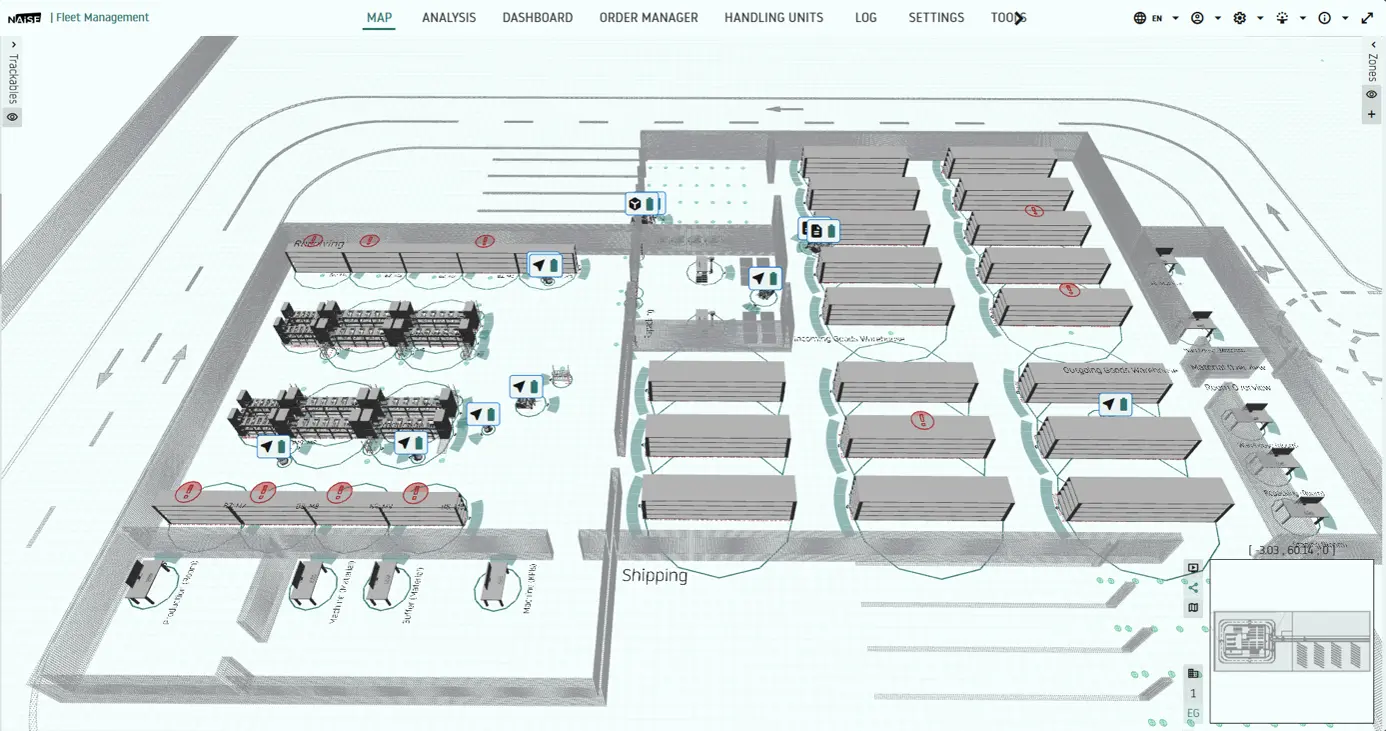
The result is a three-dimensional representation of a factory environment in which the entire material flow becomes visible. From inbound trucks at the gate to staging areas, warehouse operations, repacking processes, production lines, and outbound shipping, all steps are mapped within a single, consistent model. What makes this approach particularly powerful is that the data behind these processes can originate from completely different systems, yet is displayed in one unified environment.
The images below provide an impression of how the 3D Control Tower makes material flows and system states visible at a glance.
Data Where It Matters
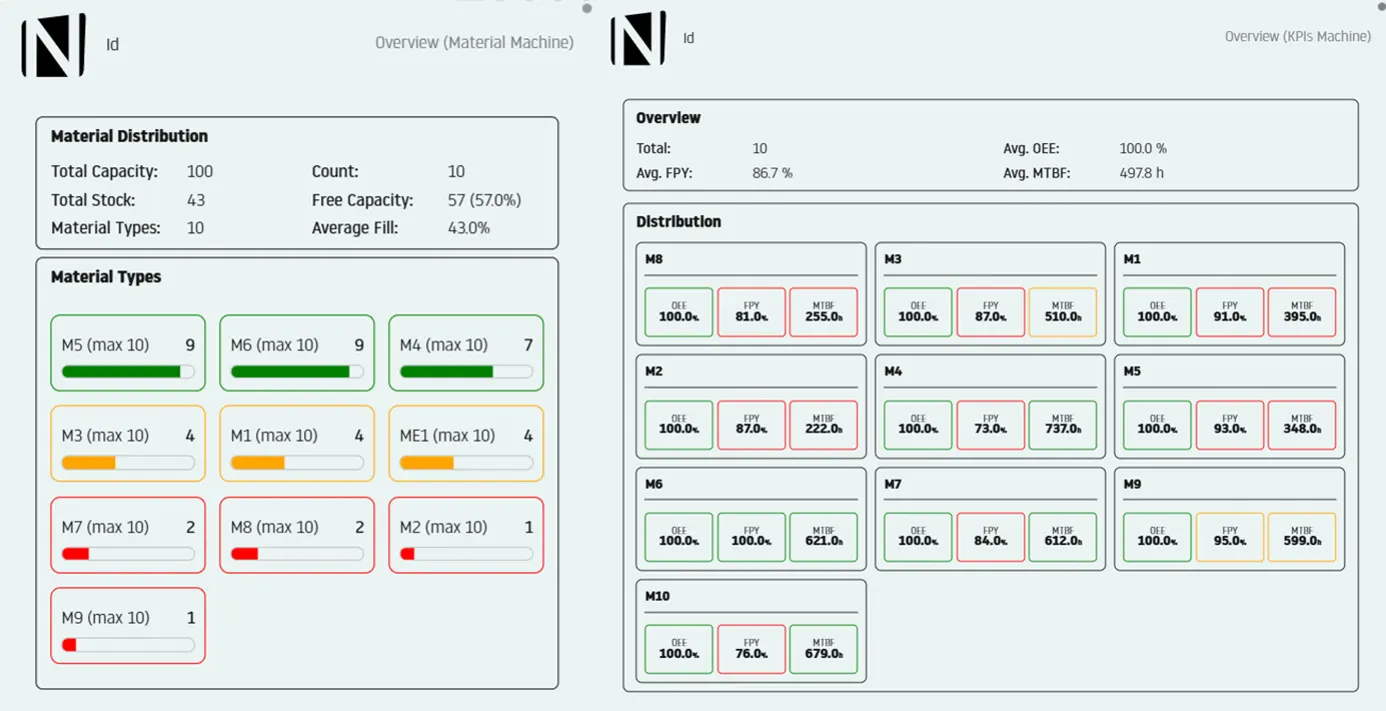
Instead of navigating through multiple tools, users interact with information directly where it is generated. Machines, storage systems, and infrastructure elements are represented as objects within the 3D space, each capable of displaying its own data. Key performance indicators, operational statuses, and error messages appear exactly at the point of relevance. Even aggregated information, such as overall throughput or the status of multiple production lines, can be visualized through dedicated elements within the environment.
Flexible Integration Through NAiSE
A central role in this concept is played by NAiSE’s OEE display functionality. In the project, it was used to integrate and visualize data in a highly flexible way. Information is transmitted via MQTT and defined as HTML-based content, allowing each object to display customized views. This approach makes it possible to design individual interfaces for different use cases without being limited to predefined formats. As a result, virtually any system that can provide data can also be represented within the 3D environment.
From Layout to 3D Model
One of the more surprising findings of the project is how accessible the creation of such a 3D model can be. Starting from a simple two-dimensional layout, the environment can be transformed into a three-dimensional representation using standard tools and then converted into a format compatible with NAiSE. This process enables the rapid development of realistic yet manageable digital environments, making the concept applicable even without extensive modeling effort.
Within a period of just three months, the project progressed from an initial idea to a functional proof of concept. During this time, a complete virtual factory was created, data flows were simulated, interfaces were connected, and interactive visualizations were implemented. Even complex elements such as warehouse systems or production equipment were represented as digital objects with their own data logic. The implementation relied on a combination of modeling tools, data simulation, and standard interfaces such as MQTT and REST, demonstrating how existing technologies can be combined into a coherent system.
Towards an Operational Digital Twin
Although the prototype is based on simulated data, it clearly illustrates the potential of the approach. According to common maturity models for digital twins, the system currently corresponds to a level where processes are connected and visualized but not yet synchronized with real-time physical systems. With the integration of live data, this concept could evolve further towards a more comprehensive digital twin with real-time synchronization, advanced analytics, and potential predictive capabilities.
The 3D Control Tower represents a new way of interacting with operational data. Instead of acting as isolated tools, intralogistics systems become part of an integrated operational layer that supports decision-making directly within the process context.
The findings of this project suggest that NAiSE is well positioned to play a central role in this development. By combining data integration, visualization, and operational logic within a single platform, it provides a foundation for a new generation of digital solutions — where transparency is no longer an added feature, but a core capability.
A Remarkable Achievement
What makes this project particularly remarkable is the speed and quality of its execution. Within just three months, Annkatrin Gießler transformed an initial idea into a fully functional prototype. This achievement was made possible by her exceptional discipline, her ability to quickly familiarize herself with new technologies, and her determination to refine every detail. Her creativity and persistence played a key role in shaping the concept into what it is today.